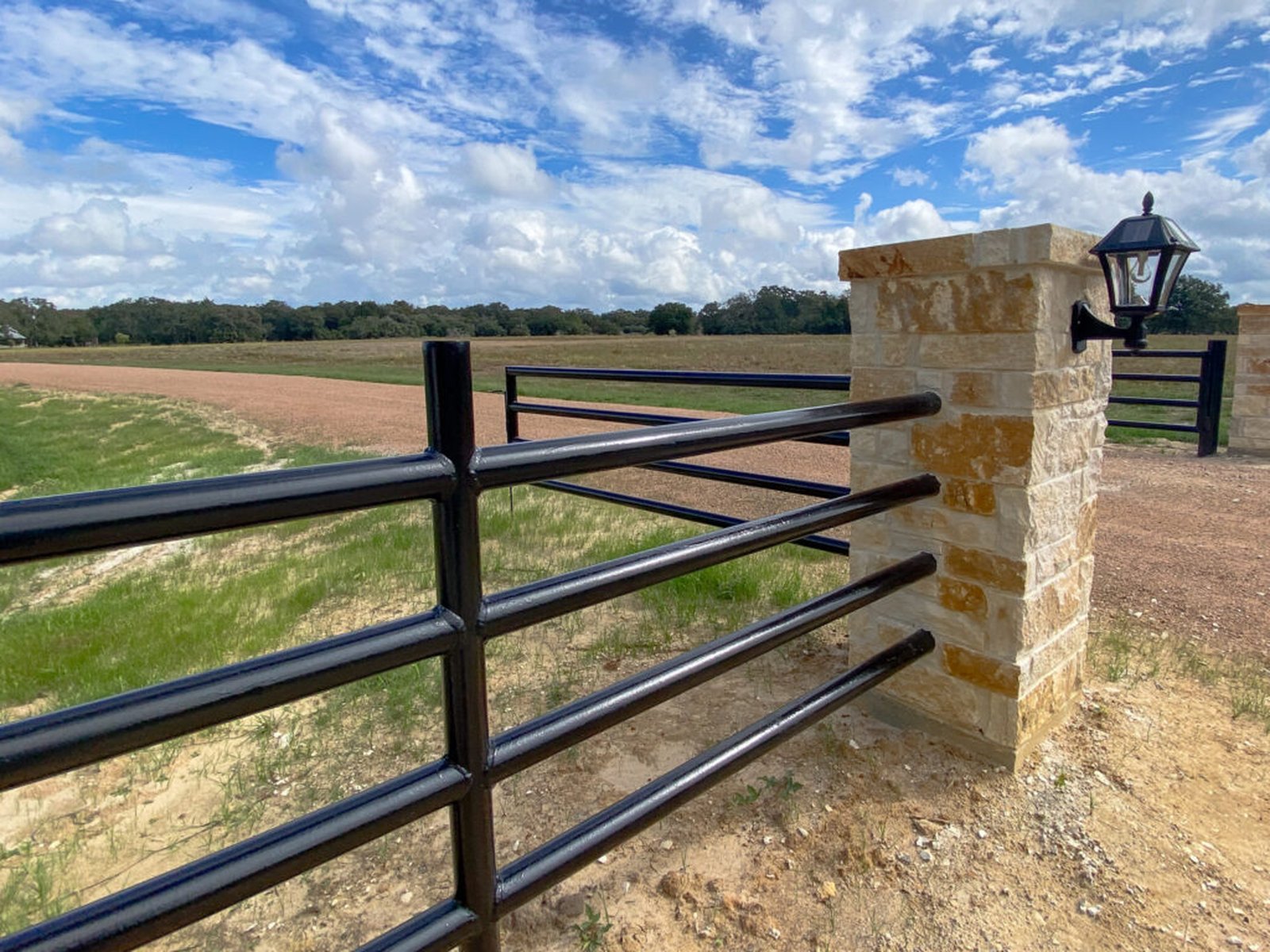
Elevation F-5 — brace assembly and wire runs
Welded pipe, barbed wire, woven field wire and tube gates — for the land north of the loop where a residential fence is the wrong tool.
On acreage, the cost is not in the wire. It is in the corners, the gate posts and the braces, because those are the points that carry every pound of tension in the run.
An H-brace spans roughly twice the post height between the anchor post and the brace post. Undersize it and the corner walks out of the ground over a couple of seasons, taking the whole run slack with it.
Pipe is the most durable and the most expensive — usually reserved for entrances, road frontage and working pens rather than the entire perimeter. Barbed wire on T-posts handles cattle; woven field wire holds smaller stock and is the better call for goats or sheep.
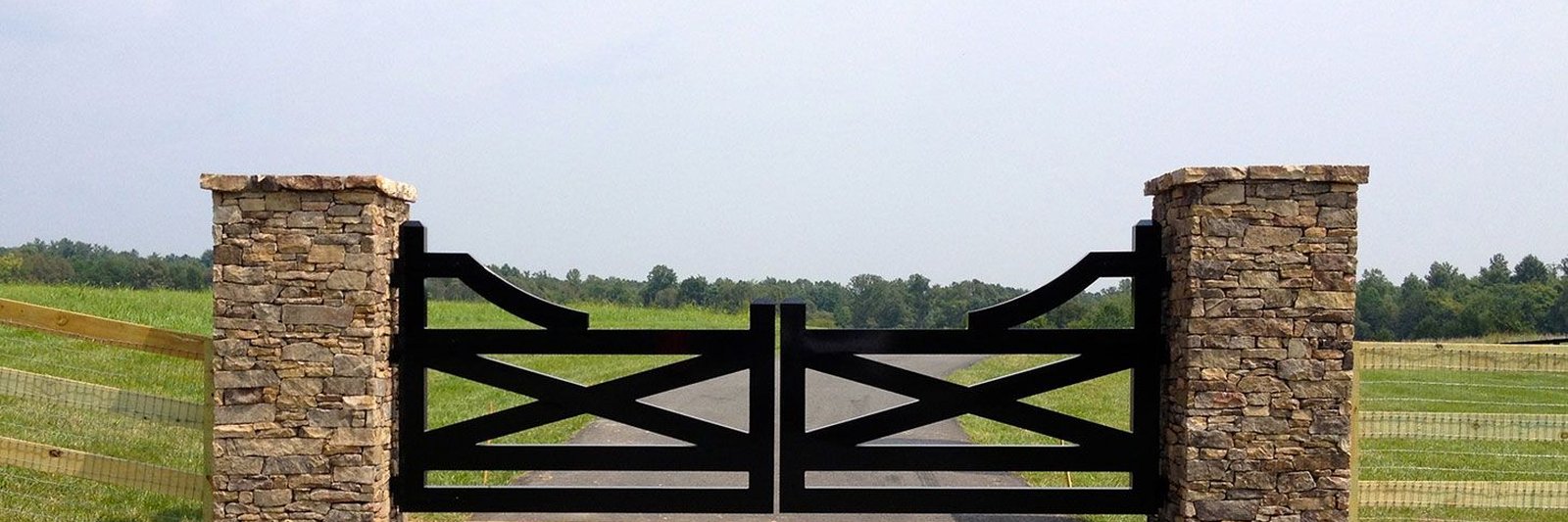
This is the configuration pipe is worth paying for — road frontage and the entrance, where the fence is seen and where livestock pressure concentrates. Running it around an entire section perimeter is rarely worth it; wire does that job for a fraction of the price.
Four rails rather than three closes the gap at the bottom enough to hold calves. The rails are welded through the posts, not clamped to them, which is what keeps the line from racking when an animal leans on it.
Masonry columns at the entrance are a separate trade from the fence itself, and they are also the point where the two jobs have to be coordinated: if the gate will ever be powered, the conduit and the operator pad have to be set before the column goes up. Retrofitting means taking stone back off. See gate operators.
If the entrance gate will ever be powered, the columns, the conduit run and the loop have to be planned before the concrete goes in. Retrofitting means cutting it back out. See Gate operators.
Mesquite and huisache along an old fence line come out before anything new goes in. That is its own line on the estimate, and it is worth walking the line together before we price it.
Pipe at the entrance, the road frontage, and the working pens, where the fence is seen and where livestock pressure concentrates. Wire for the rest of the perimeter. Running pipe around an entire section is rarely worth the cost when wire does the same containment job.
Commonly eight to twelve feet on a straight run, tightened up on uneven ground. What actually determines whether the fence holds is the corner and gate assemblies — an undersized brace walks out of the ground over a couple of seasons and takes the whole run slack with it.
City fence rules generally stop at the city limits, but county requirements, utility easements, and road setbacks still apply. Check before you set posts, particularly along a county road or anywhere a utility easement crosses the line.
Yes, and it is far cheaper to plan it before construction. The columns, the conduit run, and the exit loop need to be in place before concrete is poured and stone goes up. Retrofitting power to a finished entrance means cutting concrete and removing stone.